

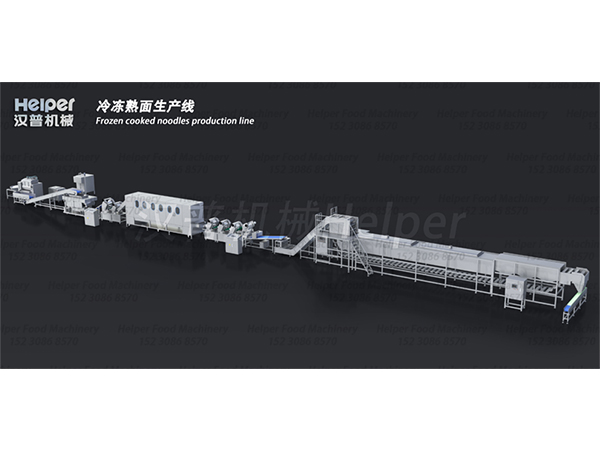
A variety of faults may occur during the operation of a noodle production line.
First of all, problems arise in noodle forming. Uneven noodle thickness is usually caused by improper adjustment of the roller gap. The clearance between pressing rollers needs to be recalibrated to ensure uniform spacing, so that noodles can be extruded to a consistent thickness when passing through. Rough noodle surfaces with wrinkles or lumps often result from inappropriate dough humidity. Over-dry dough tends to form wrinkles, while over-wet dough easily sticks together and creates lumps. Operators should precisely control dough moisture content according to flour characteristics and equipment requirements.
Secondly, conveying malfunctions frequently happen. Conveyor belt mistracking is a typical fault, generally caused by inconsistent tension on both sides of the belt. It is necessary to inspect and adjust the belt tensioning device to balance tension on two sides for stable belt operation. Loose or noisy transmission chains may be triggered by component wear or insufficient lubrication. Worn chain parts shall be replaced in a timely manner, and proper lubricant should be applied to reduce friction between chains and sprockets and extend service life.
Thirdly, cutting-related defects occur. Noodles cut into inconsistent lengths are often attributable to worn cutters or faults in the cutting transmission mechanism. Regularly check cutter wear status, replace blunt cutters promptly, maintain and adjust the cutting transmission system to guarantee accurate and stable cutting actions and produce noodles of specified lengths.
In addition, electrical failures are quite common. Failure to start motors may stem from motor defects, faulty power wiring or control system malfunctions. Check whether motor power cables are firmly connected, verify motor windings for short circuits or open circuits, and confirm normal operation of relays, contactors and other components in the control system. Inaccurate temperature control affects noodle maturing quality, which may be caused by damaged temperature sensors or malfunctioning temperature regulators. Replace defective sensors and calibrate parameters of the temperature control system.
Finally, cleaning and maintenance cannot be overlooked. Dough residues will accumulate inside the equipment after prolonged operation. Without timely cleaning, equipment performance will be impaired and further faults may be triggered. Carry out comprehensive regular cleaning of the whole line, focusing on components in contact with dough, to maintain good operating conditions.