

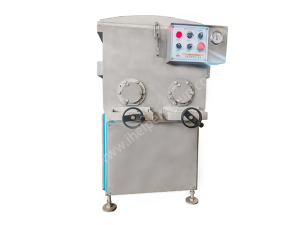
A noodle production line is an advanced noodle processing machine featuring vacuum dough mixing and photoelectric control technology. With social development, it is now widely used in the flour product manufacturing and processing industry, creating greater economic benefits. So what are the specific composition systems and characteristics of a noodle production line?
In compliance with food safety standards, all parts in the production line that come into contact with processing materials are made of food-grade materials and stainless steel. Its excellent structural design and high degree of automation make its high-quality products very popular in both domestic and international markets.
The surface of the rollers is polished by a grinding machine, making them smooth and aesthetically pleasing. The rolled dough sheets are flat and smooth, ensuring the quality of the noodles. The machine features a reasonable design, adopting a reducer and sprocket drive, resulting in low noise and a compact structure.
The hob is installed at the rear part of the production line and adjusted via a variable frequency speed control device, which can freely cut noodles to the set length without weighing.
Characteristics of the Fully Automatic Noodle Production Line
All working procedures from flour feeding to finished product production can be completed automatically.
The grinding rollers of the machine are finely, smoothly and neatly ground.
The rolled dough sheets are smooth and glossy, guaranteeing the quality of the noodles.
1. Flour Conveying System
Purpose: This unit uniformly and quantitatively delivers the screened flour to the filtered air storage tank through pneumatic conveying.Features: High productivity; can be installed according to on-site requirements; flour bins can be set separately for easy cleaning and simple maintenance.
2. Flour Mixing System
The dough mixing equipment consists of pneumatic flour conveying, a salt-water mixer, a two-speed double-shaft dough mixer, and an electric control cabinet. It controls the dosage of flour and mixed salt water, atomizing the salt water for mixing with flour to produce loose dough with uniform moisture content.
3. Compound Continuous Rolling and Cutting System
This system includes a dough ripening machine, a compound rolling machine, a continuous sheeting machine, a cutting machine, and a stick hanging machine — five units as a group to complete the noodle forming stage. After 10 minutes of ripening, the mixed dough enters the compound rolling machine to form a dough sheet, which is then rolled by 8 rollers into a sheet of 0.8–2 mm thick. After passing through the cutting knife, the rolled dough is cut into wet noodles of 0.8–6 mm in various specifications. The stick feeding machine hangs noodles of 2400–2600 mm long onto parallel chains, controlled by photoelectric or proximity switches, and synchronously sent to the hanging rack drying device. The end cutting machine is installed at the starting point of the drying process.
4. Drying System
The new low-temperature Chinese-style noodle production line includes main drying drive, hanging chains, hanging equipment, steel-structured cooling ceiling fans, dehumidification fans, air heaters, sensors, temperature and humidity controllers, electric control cabinets, etc. The hanging chain conveyor runs with a stepless variable frequency motor, conveying noodles into the drying zone.
5. Noodle Unloading System
Composed of a discharging machine, a cutting and arranging machine, a multi-blade or intelligent single-pole noodle cutter, an electric control cabinet, etc. After 5 hours of drying, the dried noodles are fed into the noodle cutter and cut into stick-shaped noodles of adjustable length (from 100 mm to 300 mm), then packaged according to the required weight.