

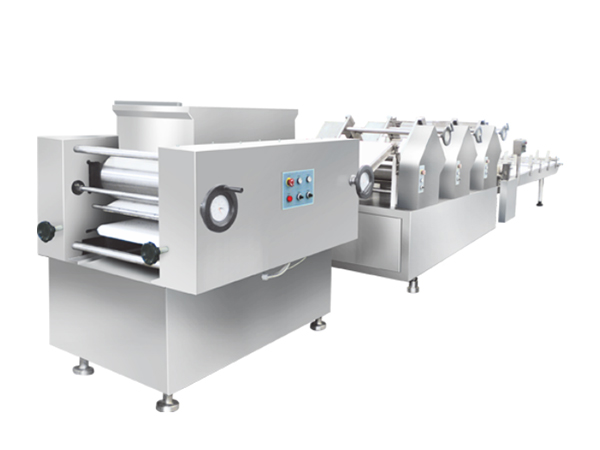
The core function of gears in noodle making machine is to efficiently transmit power from the motor to the dough rollers and mixing shafts. They reduce speed to boost torque to deliver sufficient extrusion force and adjust transmission direction for stable rolling and forming.
1.Power Transmission, Speed Reduction and Torque Boost
The motor outputs high speed with low torque. Meshed gears reduce the rotational speed and greatly increase the output torque at the dough rollers, ensuring stable rolling of high-gluten dough without stalling.
2.Transmission Direction Conversion
Bevel gears or worm gear sets convert the axial rotation of the motor into vertical or parallel axial rotation required by dough rollers, optimizing the internal space layout of the machine.
3.Synchronization and Precise Control
For multi-roller or multi-functional models, gears enable strict synchronous operation of multiple dough rollers, as well as mixing and extrusion components. This guarantees uniform dough sheet thickness and synchronized delivery of dough and filling (for filled noodle machines).
4.Stable Operation and Noise Reduction
Precision gears (such as helical gears and plastic-steel gears) achieve more stable meshing compared with belt transmission, lowering vibration and noise and improving the continuity of dough rolling.
5. Practical Performance in Different Application Scenarios
Household electric dough pressing machines: Gears mainly drive the opposite rotation of dough rollers. The gearbox lowers rotating speed and increases pressure to repeatedly stretch dough into even dough sheets.
Automatic mixing and noodle integrated machines: Some models adopt gear transmission to realize linkage or independent driving of mixing hooks and dough rollers, matching mixing intensity with noodle output speed.
Commercial filled noodle machines: Heavy-duty gearboxes withstand continuous high-load operation and ensure strict synchronization between the extruder for noodle wrappers and filling extruders, preventing wrapper rupture or uneven filling distribution.
The precision of the gear system directly determines the durability of noodle machines, rolling force and uniformity of finished noodles. It serves as a key component distinguishing gear-driven models from belt-driven alternatives.