

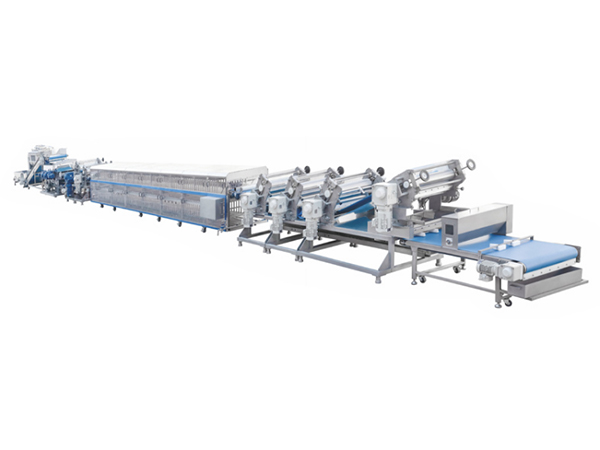
When mass noodle sticking occurs on the noodle production line, troubleshoot step by step in process sequence from front-end dough rolling to back-end cooling. Targeted adjustments can resolve the issue quickly and prevent losses from bulk defective products.
1. Adjustments for Front-end Dough Rolling Process
Calibrate roller parallelism and control the gap error on both sides of dough rollers within 0.02 mm, to ensure uniform dough sheet thickness and avoid subsequent sticking caused by uneven moisture content in local dough masses.
Adjust dough moisture content. Strictly control water addition during dough mixing within the range of 30%–35%. Reduce water addition by 2%–3% appropriately under high-humidity environments to lower free moisture on noodle surfaces at the source.
Clean cutting knives regularly to remove dough residues trapped between cutter teeth, ensuring clean cutting of noodles and preventing stringing and sticking at noodle cross-sections. Install miniature air-cooling fans at the cutter station to rapidly form a dry film on the surface of freshly cut noodles.
2. Optimization of Cooking Process
Strictly control cooking duration: shorten the standard cooking time by 30 seconds. Remove noodles from the cooker when they reach 80%–90% doneness. Overcooking causes massive starch precipitation and significantly increases surface stickiness.
Replace cooking water periodically. Fully renew the water every 2 hours of continuous cooking to prevent continuous build-up of starch concentration in the water, which creates a viscous starch layer on noodle surfaces after discharge and leads to sticking.
3. Cooling and Setting
Immediately transfer cooked noodles into the high-pressure water blowing module to rapidly remove all free moisture on noodle surfaces, eliminating risks of stickiness caused by mixed oil and water.
Activate the 360° annular circulating air cooling system to quickly reduce the core temperature of noodles below 25°C within 3 minutes. This instantly stops continuous starch gelatinization and fundamentally prevents mushy noodle sticking induced by residual heat stewing.
Equip a flexible loosening mechanism to gently comb and break noodle clumps without damage. No noodle breakage occurs during processing, leaving individual noodles separated. An intelligent quantitative oil spraying device then atomizes a small amount of edible oil to evenly coat each noodle, forming an isolation film to completely eliminate secondary sticking.
All process parameters of the noodle production line must be accurately stored by noodle type. When switching between alkaline noodles, egg noodles and other varieties, recall corresponding parameters with one click to avoid batch sticking problems caused by repeated manual parameter adjustment.